

Acoustic Emission Knowledge
Sensor Coupling and Installation for Acoustic Emission Monitoring
Brief:Sensor Coupling and Installation for Acoustic Emission Monitoring RSensor coupling and installation refer to the methods used to attach acoustic emission (AE) sensors to a structure and ensure efficient transmission of elastic waves from the material surface to the sensor. Proper coupling and installation are essential because AE signals are often extremely weak and highly sensitive to interface conditions. Even high-performance sensors can produce poor results if installation quality is inadequ
Sensor Coupling and Installation for Acoustic Emission Monitoring
Sensor coupling and installation refer to the methods used to attach acoustic emission (AE) sensors to a structure and ensure efficient transmission of elastic waves from the material surface to the sensor.
Proper coupling and installation are essential because AE signals are often extremely weak and highly sensitive to interface conditions. Even high-performance sensors can produce poor results if installation quality is inadequate.
Why Coupling Matters
Acoustic emission waves must travel through multiple interfaces before reaching the sensing element.
Without proper coupling:
- signal amplitude decreases,
- frequency response is distorted,
- noise sensitivity increases,
- and weak events may not be detected.
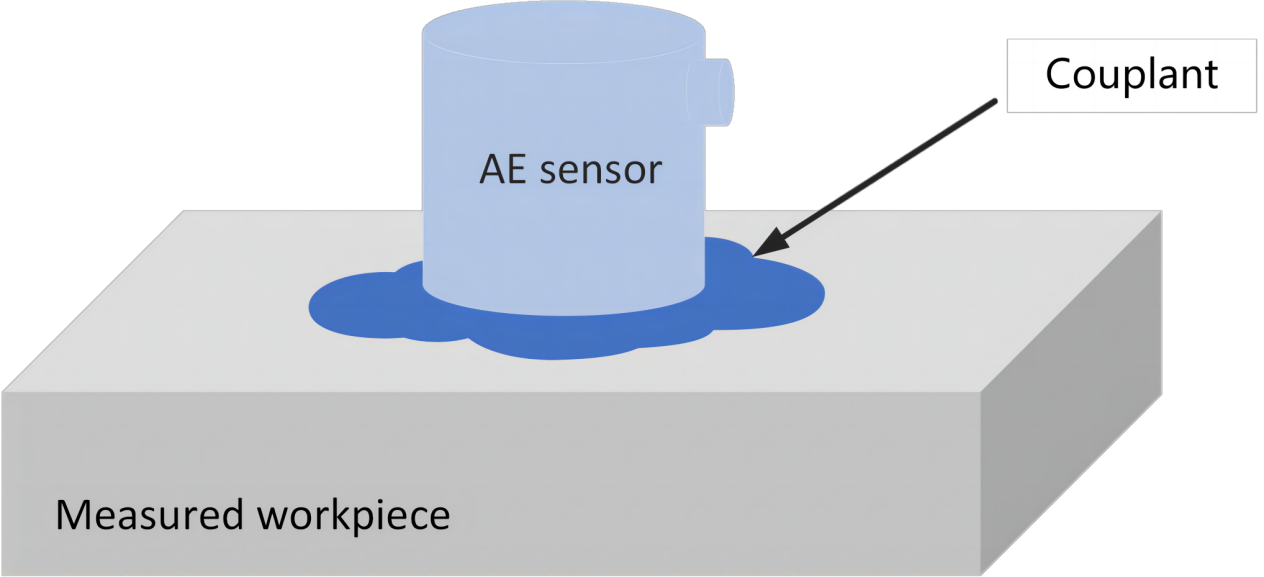
Basic Principle of Coupling
Air gaps between the sensor and the structure significantly reduce wave transmission efficiency.
Purpose of Coupling
Coupling materials are used to:
- eliminate microscopic air gaps,
- improve acoustic transmission,
- and stabilize sensor contact.
The goal is to create the most efficient mechanical path between:
- the structure surface, and
- the sensor face.
Common Coupling Materials
Different applications require different coupling materials depending on temperature, surface condition, and installation duration.
1. Grease or Silicone Couplant
Characteristics
- Easy to apply and remove
- Good acoustic transmission
- Suitable for temporary testing
Typical Applications
- Laboratory experiments
- Short-term inspections
- Sensor repositioning
Limitationss
- May degrade over time
- Not ideal for harsh environments
2. Adhesive Couplant
Characteristics
- Strong mechanical stability
- Suitable for long-term monitoring
Typical Applications
- Permanent SHM systems
- Outdoor installations
Limitations
- Difficult to remove
- May affect sensor reuse
3. High-Temperature Couplant
Characteristics
- Designed for elevated temperatures
- Maintain stability under thermal cycling
Typical Applications
- Pressure vessels
- Industrial process equipment
Limitations
- More complex installation
- Specialized handling may be required
Surface Preparation
Surface condition directly affects coupling quality.
Recommended Preparation Steps
- 1. Remove dirt, paint, rust, or loose material
- 2. Smooth rough surfaces if necessary
- 3. Clean the area thoroughly
- 4. Ensure the surface is dry before installation
Why Surface Preparation Is Important
Poor surface conditions can cause:
- signal attenuation,
- inconsistent response,
- or unstable sensor contact.
A clean and stable contact surface improves repeatability and signal quality.
Sensor Mounting Methods
The installation method affects both coupling stability and operational practicality.
Advantages
- Fast installation
- Reusable
- Convenient for temporary measurements
Limitations
- Reduced coupling consistency
- Not suitable for non-ferromagnetic materials
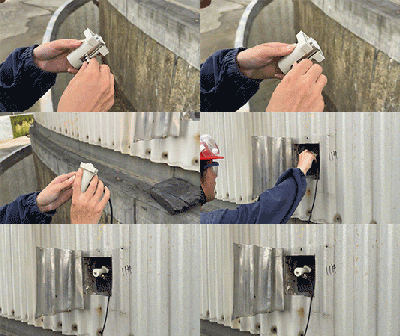
2. Adhesive Bonding
Advantages
- Stable long-term coupling
- Reliable signal transmission
Limitations
- Difficult removal
- Potential sensor damage during removal
3. Mechanical Clamping
Advantages
- Strong contact pressure
- Suitable for harsh environments
Limitations
- More complex installation
- Requires access and mounting hardware
Sensor Placement Considerations
Correct sensor placement is as important as coupling quality.
Distance Between Sensors
Sensor spacing depends on:
- material attenuation,
- structure geometry,
- and expected signal amplitude.
Large spacing may reduce detection sensitivity.
Avoid High-Noise Areas
Sensors should be placed away from:
- rotating machinery,
- loose components,
- strong vibration sources,
- or electromagnetic interference.
Coverage and Redundancy
Multiple sensors are often required to:
- improve source localization,
- reduce missed events,
- and increase reliability.
Coupling Quality Verification
After installation, coupling quality should always be verified.
Common Verification Methods
Pencil Lead Break Test (Hsu-Nielsen Source)
A simulated AE source used to:
- verify sensor response,
- evaluate coupling consistency,
- and check system functionality.
Signal Comparison
Engineers may compare:
- signal amplitude,
- waveform shape,
- or frequency response between sensors.
Large differences may indicate poor coupling.
Effects of Poor Coupling
Poor coupling can lead to serious monitoring errors.
Typical Problems
- Reduced sensitivity
- Distorted frequency response
- Missed low-amplitude events
- Increased variability between sensors
In severe cases, valid AE activity may not be detected at all.
Environmental Considerations
Long-term monitoring systems must consider environmental effects.
Temperature
Thermal expansion may affect contact pressure and couplant stability
Moisture
Water ingress may degrade coupling materials or introduce noise.
Vibration
Mechanical vibration may loosen sensors over time.
Long-Term Monitoring Considerations
For permanent monitoring systems:
- use stable coupling materials,
- protect cables and connectors,
- periodically verify sensor response,
- and inspect installation integrity.
Reliable installation is essential for maintaining data quality over months or years.
Practical Engineering Recommendations
For Temporary Testing
- Use grease or silicone coupling
- Magnetic holders may be sufficient
For Long-Term SHM
- Use adhesive or mechanical fixation
- Protect sensors from environmental exposure
For Noisy Environments
- For Noisy Environments
- Minimize cable movement
- Verify grounding and shielding
Frequently Asked Questions
1) Is coupling really necessary?
Yes. Without proper coupling, acoustic waves cannot efficiently transfer into the sensor.
2) Can sensors be mounted directly on painted surfaces?
In most cases, paint should be removed to improve transmission consistency.
3) How often should coupling be checked?
For long-term systems, periodic verification is recommended, especially in harsh environments.
3) Does stronger mounting pressure always improve coupling?
Not necessarily. Excessive pressure may damage the sensor or distort response characteristics.
Related Topics
- Acoustic Emission Sensors Overview
- Resonant vs Broadband Sensors
- AE Signal Processing and Analysis
- Acoustic Emission System Design
Summary
Sensor coupling and installation are critical aspects of acoustic emission monitoring that directly influence signal quality and system reliability. Proper surface preparation, suitable coupling materials, stable mounting methods, and careful sensor placement are essential for effective wave transmission and accurate monitoring results. In both temporary testing and long-term structural health monitoring, installation quality plays a major role in overall system performance.