

Acoustic Emission Knowledge
What Is Acoustic Emission (AE)?
Brief:Acoustic Emission (AE) is a passive nondestructive testing and structural health monitoring technique that detects transient elastic waves generated by the rapid release of energy from localized sources within a material or structure.
What Is Acoustic Emission (AE)?
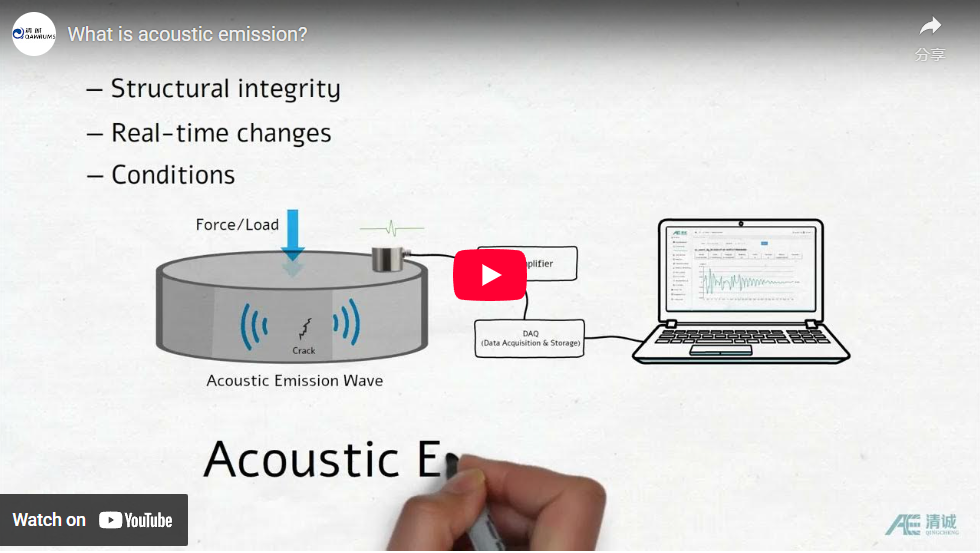
Definition of Acoustic Emission
Acoustic Emission (AE) is a passive nondestructive testing and structural health monitoring technique that detects transient elastic waves generated by the rapid release of energy from localized sources within a material or structure.
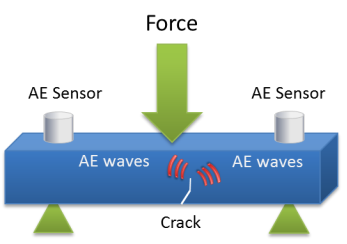
These elastic waves are typically produced by phenomena such as:
- crack initiation and propagation,
- plastic deformation,
- fiber breakage in composites,
- friction between structural components,
- or fluid leakage under pressure.
Unlike active inspection methods, acoustic emission monitoring listens to signals generated by the structure itself while it is under load or in service.
How Acoustic Emission Works
Acoustic emission monitoring is based on a simple physical principle:
When a material undergoes irreversible internal changes, part of the released energy propagates as elastic stress waves.
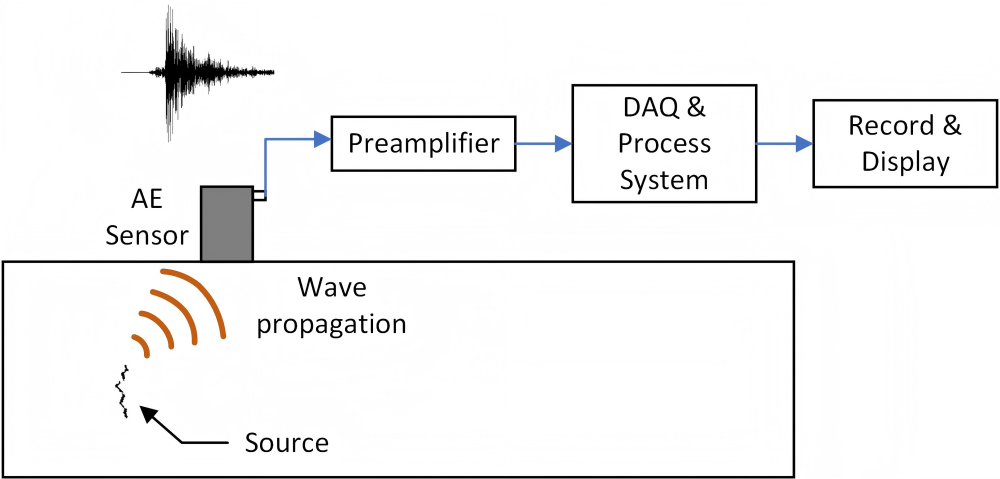
Basic Workflow
1. Energy Release
Structural activity (e.g., crack growth) releases elastic energy.
2. Wave Propagation
Stress waves travel through the material.
3. Signal Detection
AE sensors mounted on the surface detect surface displacements.
4. Signal Conditioning
Signals are amplified, filtered, and digitized.
5. Data Analysis
Signal features are extracted to characterize source activity.
Because AE is passive, it does not introduce external excitation into the structure.
Typical Sources of Acoustic Emission
Acoustic emission signals originate from active damage mechanisms, not from static defects.
Common AE Sources
- Crack initiation and growth
- Plastic deformation
- Corrosion-related processes
- Delamination in composite materials
- Fiber breakage
- Friction or fretting
- Fluid or gas leakage
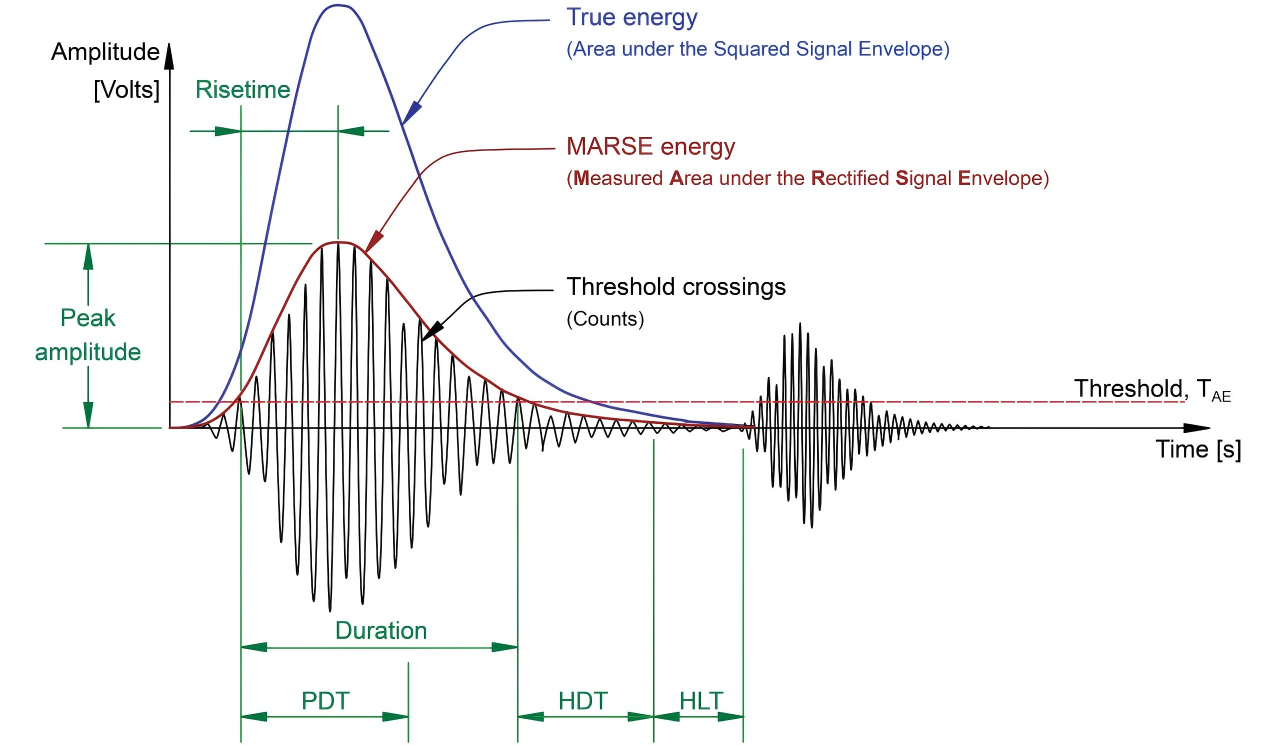
Each source type produces characteristic signal features related to:
- amplitude,
- frequency content,
- duration,
- and energy.
Passive vs Active Monitoring
One of the defining characteristics of acoustic emission is that it is a passive technique.
Passive Nature of AE
| Aspect | Acoustic Emission |
| External excitation | Not required |
| Signal origin | Structure itself |
| Detection focus | Active damage |
| Typical operation | Under load or service |
In contrast, methods such as ultrasonic testing require externally generated waves and are typically performed during inspections rather than continuous operation.
Burst Signals and Continuous Signals
AE signals are generally classified into two categories.
Burst-Type Signals
- Short duration
- High amplitude
- Associated with discrete events (e.g., crack growth)
Continuous-Type Signals
- Longer duration
- Lower amplitude
- Associated with ongoing processes (e.g., leakage, friction)
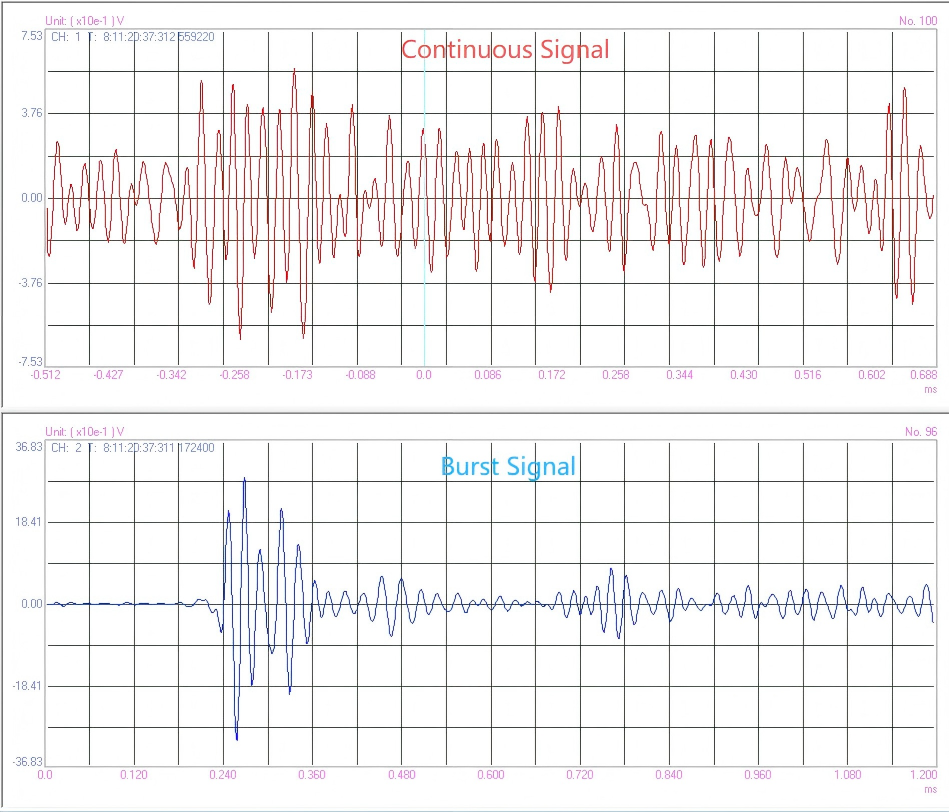
Understanding signal types is essential for correct interpretation and noise discrimination.
Key Advantages of Acoustic Emission Monitoring
Acoustic emission offers several advantages compared with traditional nondestructive testing methods.
Main Strengths
-
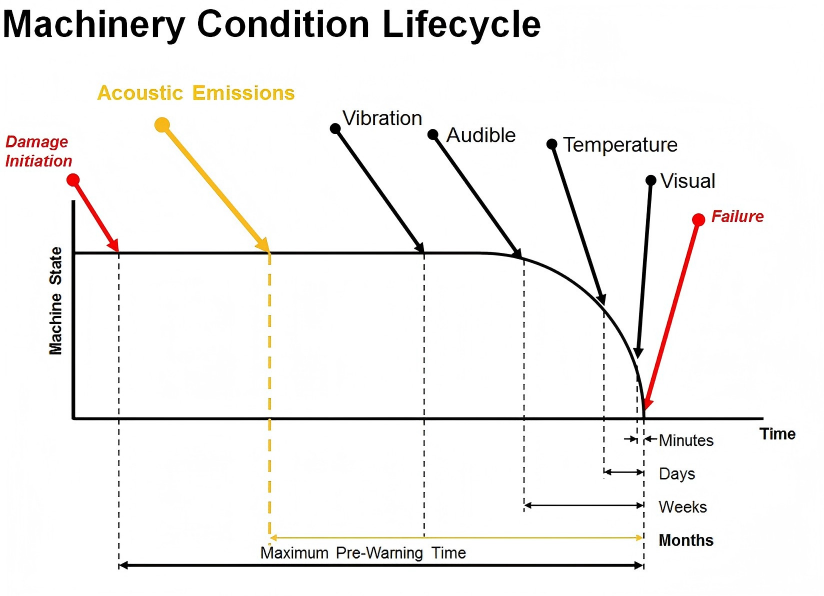
Early damage detection
AE can detect damage initiation before visible defects appear. -
Global monitoring capability
A limited number of sensors can cover large structures. -
Real-time monitoring
Suitable for continuous and online structural health monitoring. -
In-service inspection
Structures can be monitored under actual operating conditions.
Limitations of Acoustic Emission
Despite its advantages, acoustic emission is not universally applicable.
Key Limitations
- Sensitive to environmental and operational noise
- Requires loading or active damage processe
- Interpretation depends on expertise and signal processing
- Quantitative defect sizing is challenging
Understanding these limitations is essential for appropriate application.
Typical Applications of Acoustic Emission
Acoustic emission monitoring is widely used in engineering fields where early damage detection is critical.
Common Application Areas
- Bridge and civil infrastructure monitoring
- Pressure vessels and storage tanks
- Pipelines and leak detection
- Wind turbine blades
- Composite material testing
- Aerospace structures
In many cases, AE is used as part of a hybrid monitoring strategy together with other sensing techniques.
Acoustic Emission in Structural Health Monitoring
In structural health monitoring (SHM), acoustic emission plays a unique role:
- Detecting when and where damage initiates
- Providing early warning of abnormal structural behavior
- Supporting condition-based maintenance strategies
AE does not replace all inspection methods but complements them by focusing on damage activity rather than static condition.
Frequently Asked Questions
Is acoustic emission a destructive testing method?
No. Acoustic emission is a nondestructive technique. Sensors only listen to naturally generated signals without affecting the structure.
Can acoustic emission detect very small cracks?
Yes, AE is sensitive to micro-scale damage initiation, provided that the damage process is active and produces elastic waves.
Does acoustic emission work without loading?
Generally, AE requires stress, pressure, or environmental changes that activate damage mechanisms.
Is acoustic emission suitable for long-term monitoring?
Yes. AE is commonly used for continuous and long-term monitoring of critical structures.
Related Topics
- Acoustic EmissionSensors and Hardware
- AE Signal Processing and Feature Extraction
- Applications of Acoustic Emission Monitoring
- Acoustic Emission Standards and Guidelines
Summary
Acoustic emission is a powerful passive monitoring technique that detects elastic waves generated by active damage processes within materials and structures. By focusing on damage activity rather than static defects, AE provides early warning and real-time insight into structural integrity, making it an essential tool in modern structural health monitoring systems.