

Acoustic Emission Knowledge
Threshold and Gain Explained in Acoustic Emission Monitoring
Brief:DefinitionThreshold and gain are two fundamental parameters in acoustic emission (AE) monitoring systems that directly affect signal detection, noise filtering, and data quality.Threshold defines the minimum signal level required for the system to register an AE hit. Gain determines how much the incoming signal is amplified before analysis. Proper adjustment of these parameters is essential for reliable acoustic emission monitoring.
Threshold and Gain Explained in Acoustic Emission Monitoring
Definition
Threshold and gain are two fundamental parameters in acoustic emission (AE) monitoring systems that directly affect signal detection, noise filtering, and data quality.
- Threshold defines the minimum signal level required for the system to register an AE hit.
- Gain determines how much the incoming signal is amplified before analysis.
Proper adjustment of these parameters is essential for reliable acoustic emission monitoring.
Why Threshold and Gain Matter
AE systems often deal with extremely weak signals mixed with environmental and operational noise.
Incorrect settings may lead to:
- missed damage events,
- excessive false signals,
- distorted measurements,
- or unstable monitoring results.
In practice, threshold and gain settings are among the most important factors influencing AE data reliability.
Understanding Threshold
What Is Threshold?
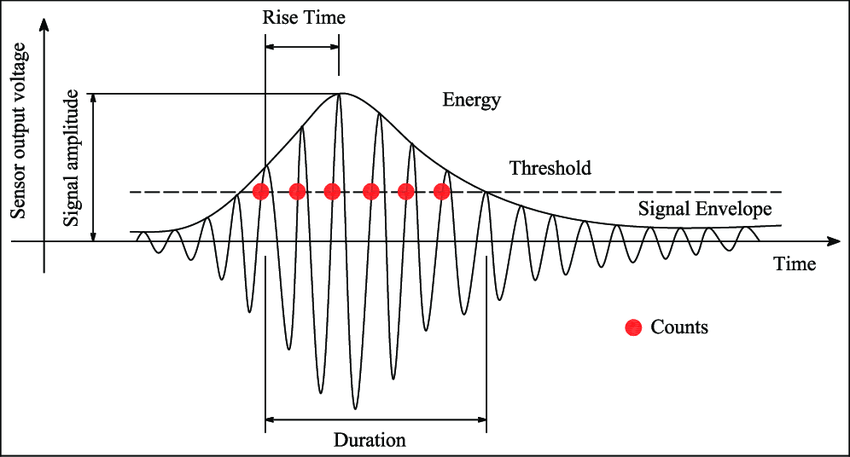
Threshold is the predefined signal amplitude level that a signal must exceed in order to be recorded as an AE hit.
Signals below the threshold are ignored by the system.
Purpose of Threshold
Threshold is primarily used to:
- reduce noise,
- prevent unnecessary data collection,
- and focus on relevant acoustic activity.
Threshold Setting Trade-offs
Selecting an appropriate threshold involves balancing sensitivity and noise rejection.
Threshold Too Low
If the threshold is set too low:
- Environmental noise may trigger hits
- Data volume increases significantly
- False indications become more common
Typical Consequences
- Unstable monitoring
- Difficult data interpretation
- Reduced confidence in results
Threshold Too High
If the threshold is too high:
- Weak signals may not be detected
- Early-stage damage may be missed
- Detection sensitivity decreases
Typical Consequences
- Loss of important information
- Delayed damage detection
Understanding Gain
What Is Gain?
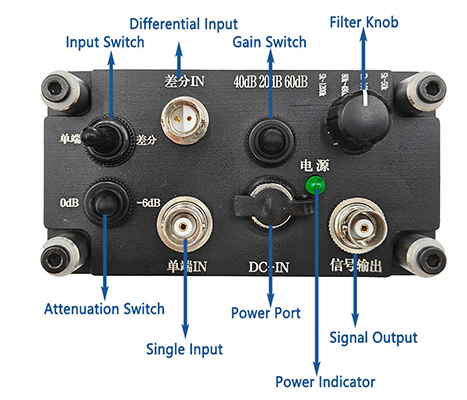
Gain is the amount of amplification applied to the AE signal before processing.

AE system usually use preamplifier right after sensors. The gain is one of the important specs of the preamplifier. It is typically expressed in decibels (dB).
Purpose of Gain
Gain is used to:
- amplify weak AE signals,
- improve signal detectability,
- and optimize system dynamic range.
How Gain Affects Signals
Higher gain increases signal amplitude before digitization.
This can:
- improve detection of small events,
- but also amplify background noise.
Gain Setting Trade-offs
Gain Too Low
If gain is too low:
- Weak signals may remain below threshold
- Detection sensitivity decreases
Typical Consequences
- Missed microcracks or low-energy events
Gain Too High
If gain is too high:
- Noise becomes amplified
- Signal distortion or saturation may occur
Typical Consequences
- Increased false hits
- Reduced measurement accuracy
Relationship Between Threshold and Gain
Threshold and gain must always be considered together.
Key Interaction
- Increasing gain effectively raises signal amplitudes
- Lowering threshold increases detection sensitivity
These parameters jointly determine:
- what signals are detected,
- and what signals are ignored.
Example Scenario
Case 1: Low Gain + High Threshold
- Very few hits detected
- Weak damage activity may be missed
Case 2: High Gain + Low Threshold
- Large number of hits
- Noise may dominate data
Case 3: Balanced Settings
- Relevant signals captured
- Noise reasonably controlled
This balance is the goal of practical AE setup.
Typical Threshold Values
Threshold settings vary depending on:
- sensor sensitivity,
- pre-amplifier gain,
- environment,
- and application.
Common Ranges
- Laboratory testing: lower thresholds
- Industrial environments: higher thresholds
There is no universal threshold suitable for all applications.
Typical Gain Values
Common pre-amplifier gain values include:
- 20 dB
- 40 dB
- 60 dB
Higher gain is often required for:
- weak signals,
- long sensor distances,
- or highly attenuating materials.
Factors Affecting Threshold and Gain Selection
1. Noise Environment
High-noise environments require:
- higher thresholds,
- or lower gain.
2. Signal Attenuation
Structures with strong attenuation may require:
- higher gain,
- or closer sensor spacing.
3. Monitoring Objective
Early Damage Detection
- Lower threshold
- Higher sensitivity
Long-Term Industrial Monitoring
- More conservative settings
- Better noise rejection
4. Sensor Type
- Resonant sensors often allow lower thresholds due to better sensitivity
- Broadband sensors may require more careful noise management
Threshold and Gain in Source Characterization
Threshold and gain settings affect measured signal parameters such as:
Because of this:
AE data collected using different settings may not be directly comparable.
Consistent setup is important for reliable trend analysis.
Practical Setup Recommendations
Initial Setup Strategy
- Observe background noise level
- Set threshold slightly above stable noise
- Adjust gain to detect expected signals
- Verify using simulated sources (e.g., pencil lead break)
During Monitoring
During Monitoring
Threshold and gain may require adjustment if operating conditions change.
- hit rate,
- waveform quality,
- and false trigger frequency.
Common Mistakes
Setting Threshold Too Low
Creates excessive false hits and unstable data.
Using Excessive Gain
Amplifies both signals and noise, sometimes causing saturation.
Ignoring Environmental Changes
Temperature, machinery activity, and operational conditions can alter noise levels over time.
Frequently Asked Questions
Is lower threshold always better?
No. Lower thresholds improve sensitivity but may significantly increase noise detection.
Does higher gain improve monitoring performance?
Not always. Excessive gain may amplify unwanted noise and distort signals.
Should threshold and gain remain constant?
For consistent analysis, stable settings are preferred unless environmental conditions change significantly.
Can threshold remove all noise?
No. Threshold helps reduce noise, but additional filtering and signal analysis are usually required.
Related Topics
- Acoustic Emission Signal Processing
- Noise Discrimination Methods
- Acoustic Emission Sensors Overview
- AE Hit and Signal Features
Summary
Threshold and gain are essential parameters in acoustic emission monitoring systems that determine signal detectability and noise rejection. Threshold defines the minimum signal level required for detection, while gain controls signal amplification. Proper adjustment of these parameters is critical for balancing sensitivity, reliability, and data quality in both laboratory and industrial monitoring applications.