

Acoustic Emission Knowledge
AE Physical Mechanisms
Brief:Acoustic emission (AE) physical mechanisms refer to the underlying material processes that generate transient elastic waves when energy is suddenly released within a structure.
AE Physical Mechanisms
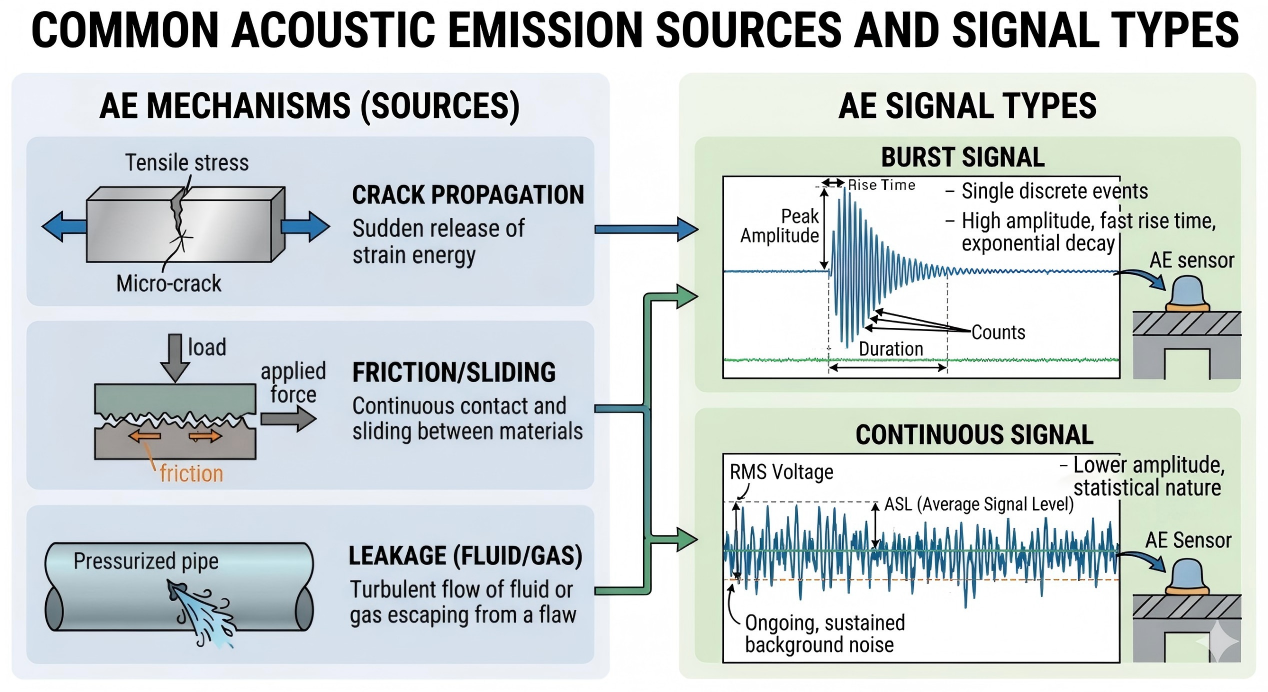
Definition
Acoustic emission (AE) physical mechanisms refer to the underlying material processes that generate transient elastic waves when energy is suddenly released within a structure.
These mechanisms are associated with irreversible changes in materials,meaning AE signals originate from active damage or deformation processes,rather than from static conditions.
Why Physical Mechanisms Matter
Understanding AE physical mechanisms is essential because:
- It allows engineers to interpret AE signals correctly
- It helps distinguish between damage-related signals and noise
- It supports source identification and classification
- It improves the reliability of structural health monitoring systems
In practice, AE does not directly measure defects—it detects the processes that create or evolve them.
Fundamental Principle of AE Generation
The generation of acoustic emission is based on a simple physical concept:
When a material undergoes rapid localized changes, part of the released strain energy propagates as elastic stress waves.
Key Conditions for AE Generation
- Energy release must be rapid
- The process must be irreversible
- The material must be able to transmit elastic waves
Slow or purely elastic (recoverable) deformation typically does not produce detectable AE signals.
Major Categories of AE Physical Mechanisms
AE sources can be broadly classified into several categories depending on the type of material behavior.
1. Crack Initiation and Propagation
Crack-related mechanisms are among the most important AE sources.
Description
- Formation of new cracks (initiation)
- Growth of existing cracks (propagation)
Characteristics
- Burst-type signals
- High amplitude
- Short duration
Engineering Relevance
- Critical for fatigue monitoring
- Early detection of structural failure
2. Plastic Deformation
Plastic deformation occurs when a material undergoes permanent shape change.
Description
- Dislocation movement within the material
- Microstructural rearrangement
Characteristics
- Lower amplitude than crack signals
- Can produce continuous or burst signals
Engineering Relevance
- Indicates stress concentration
- Often precedes crack formation
3. Friction and Contact (Fretting)
Frictional interactions between surfaces can generate AE signals.
Description
- Sliding or rubbing between components
- Micro-impacts at contact interfaces
Characteristics
- Continuous-type signals
- Wide frequency range
Engineering Relevance
- Common in bolted joints, bearings, and connections
- Can act as noise or as an indicator of loosening
4. Fiber Breakage and Matrix Cracking (Composites)
Composite materials exhibit unique AE mechanisms.
Description
- Fiber fracture
- Matrix cracking
- Fiber–matrix debonding
Characteristics
- Distinct frequency patterns
- Often multiple overlapping signals
Engineering Relevance
- Widely used in aerospace and wind turbine blades
- Enables damage mode identification
5. Corrosion Processes
Certain corrosion-related phenomena generate AE activity.
Description
- Stress corrosion cracking
- Hydrogen-induced cracking
- Oxide layer rupture
Characteristics
- Low to medium amplitude
- Often intermittent signals
Engineering Relevance
- Useful for long-term monitoring
- Indicates active degradation rather than passive corrosion
6. Fluid Leakage
Leakage generates AE through fluid dynamics effects.
Description
- Turbulent flow through small openings
- Pressure-driven jetting
Characteristics
- Continuous signals
- Frequency related to pressure and leak size
Engineering Relevance
- Common in pipelines and pressure vessels
- Enables early leak detection
Burst vs Continuous Mechanisms
AE physical mechanisms are often grouped based on signal behavior.
Burst-Type Mechanisms
- Crack growth
- Fiber breakage
- Sudden failures
Features:
- Short duration
- High amplitude
- Discrete events
Continuous-Type Mechanisms
- Leakage
- Friction
- Plastic flow
Features:
- Long duration
- Lower amplitude
- Sustained activity
Factors Influencing AE Signal Generation
Even for the same mechanism, AE signals can vary due to external factors.
Key Influencing Factors
- Material properties (elastic modulus, microstructure)
- Stress level and loading rate
- Temperature
- Geometry and boundary conditions
- Sensor distance and wave attenuation
These factors affect both signal detectability and interpretation accuracy.
From Mechanism to Measured Signal
It is important to note that:
The detected AE signal is not a direct representation of the source, but a transformed version affected by wave propagation and measurement conditions.
Signal Transformation Includes
- Attenuation
- Reflection and refraction
- Mode conversion
- Sensor response
Therefore, interpreting AE data requires understanding both:
- source mechanisms, and
- signal propagation behavior
Practical Implications for AE Monitoring
Understanding physical mechanisms helps engineers:
- Select appropriate sensor types and frequency ranges
- Set thresholds and filters correctly
- Differentiate between damage and noise
- Improve source classification and reliability
Without this understanding, AE monitoring may lead to false interpretations or missed damage.
Frequently Asked Questions
Do all material changes generate acoustic emission?
No. Only rapid and irreversible processes generate detectable AE signals. Elastic (recoverable) deformation usually does not produce AE.
Can different mechanisms produce similar signals?
Yes. Different mechanisms may generate similar signal features, which is why advanced analysis or pattern recognition is often required.
Is it possible to identify the exact mechanism from AE data?
In many cases, mechanisms can be classified, but exact identification may require additional information or complementary methods.
Related Topics
- What is Acoustic Emission
- Types of AE Sources
- AE Signal Processing and Analysis
- Noise Discrimination Methods
Summary
Acoustic emission physical mechanisms are the fundamental processes that generate elastic waves during material deformation and damage. These mechanisms include crack growth, plastic deformation, friction, corrosion, and leakage. Understanding them is essential for accurate signal interpretation, reliable monitoring, and effective use of acoustic emission in engineering applications.