

Acoustic Emission Knowledge
Types of Acoustic Emission Sources
Brief:Types of Acoustic Emission Sources Definition Acoustic emission (AE) sources are the physical origins of transient elastic waves generated within a material or structure during active processes such as deformation, damage, or interaction. TIn acoustic emission monitoring, a source does not refer to a physical location alone, but to the mechanism or activity that produces detectable signals. Why Understanding AE Sources Is Important Identifying AE sources is essential for: Interpreting signal mea
Types of Acoustic Emission Sources
Definition
Acoustic emission (AE) sources are the physical origins of transient elastic waves generated within a material or structure during active processes such as deformation, damage, or interaction.
TIn acoustic emission monitoring, a “source” does not refer to a physical location alone, but to the mechanism or activity that produces detectable signals.
Why Understanding AE Sources Is Important
Identifying AE sources is essential for:
- Interpreting signal meaning (damage vs noise)
- Classifying structural behavior
- Improving monitoring reliability
- Supporting source location and diagnostics
Because AE detects activity rather than static defects, understanding source types is critical for meaningful analysis.
Primary Classification of AE Sources
AE sources are typically classified into two main categories:
- 1.Damage-Related Sources
- 2.Non-Damage (Noise) Sources
1. Damage-Related AE Sources
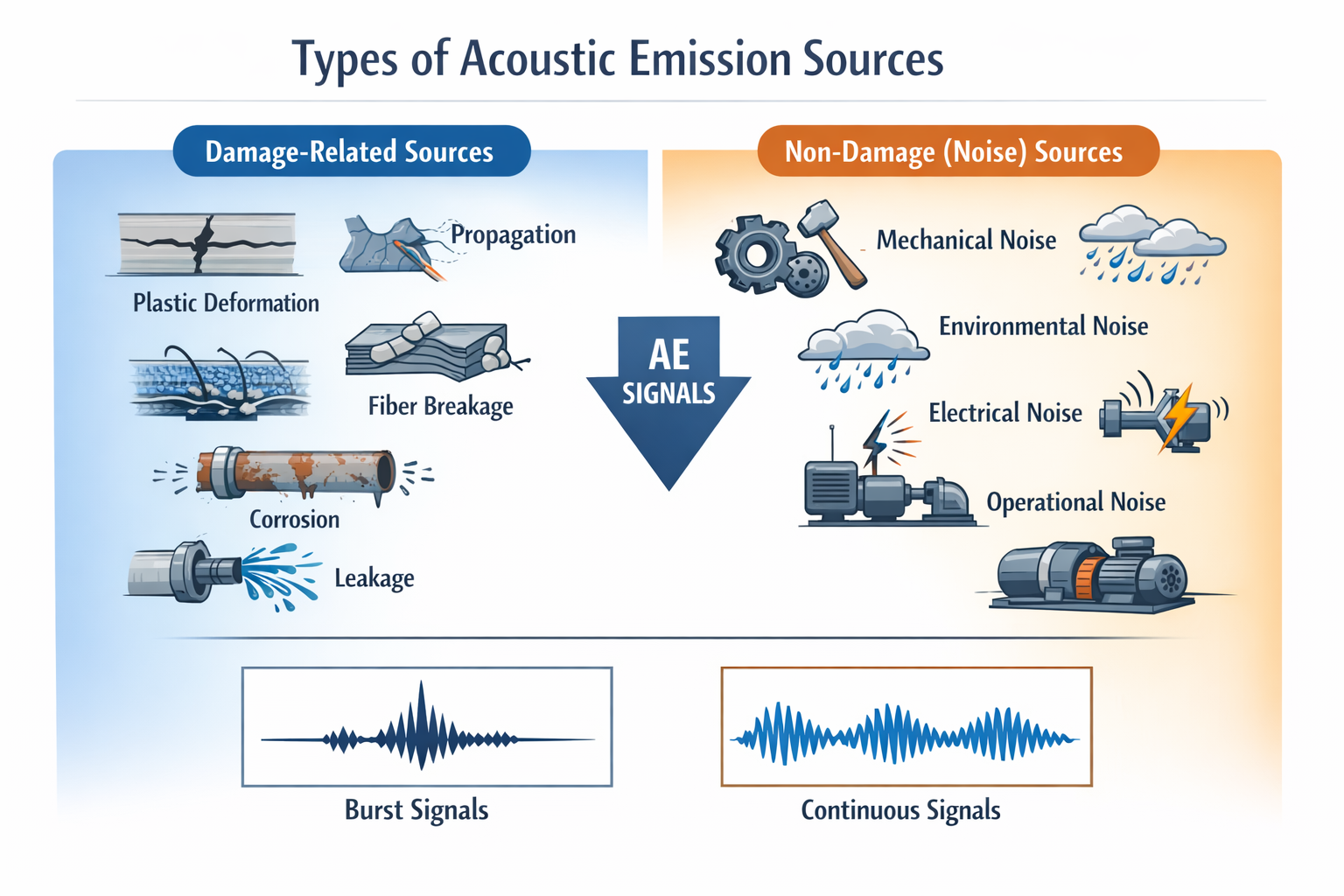
These sources are directly associated with material degradation or structural damage.
1.1 Crack Initiation
Description
The formation of new cracks due to stress concentration or material weakness.
Signal Characteristics
- Burst-type signals
- High amplitude
- Short duration
Engineering Significance
- Indicates early-stage damage
- Critical for fatigue monitoring
1.2 Crack Propagation
Description
The growth of existing cracks under continued loading.
Signal Characteristics
- Repetitive burst signals
- Increasing activity with load
Engineering Significance
- Direct indicator of structural deterioration
- Often used for failure prediction
1.3 Plastic Deformation
Description
Permanent deformation caused by dislocation movement within the material.
Signal Characteristics
- Lower amplitude than crack signals
- Can be continuous or burst-like
Engineering Significance
- Indicates stress accumulation
- Often precedes crack formation
1.4 Delamination and Debonding (Composites)
Description
Separation between layers or interfaces in composite materials.
Signal Characteristics
- Mixed signal patterns
- Moderate amplitude
Engineering Significance
- Critical in aerospace and wind turbine structures
- May not be visible externally
1.5 Fiber Breakage
Description
Fracture of reinforcing fibers in composite materials.
Signal Characteristics
- High-frequency burst signals
- Distinct signature compared to matrix cracking
Engineering Significance
- Indicates severe damage
- Often associated with loss of load-bearing capacity
1.6 Corrosion-Related Processes
Description
Electrochemical or stress-assisted degradation processes.
Examples
- Stress corrosion cracking
- Hydrogen-induced cracking
Signal Characteristics
- Intermittent signals
- Lower amplitude
Engineering Significance
- Indicates active material degradation
- Useful for long-term monitoring
1.7 Leakage
Description
Fluid or gas escaping through small openings under pressure.
Signal Characteristics
- Continuous signals
- Frequency related to flow conditions
Engineering Significance
- Early detection of leaks in pipelines and vessels
- Often detectable before visible signs appear
2. Non-Damage AE Sources (Noise)
Not all detected AE signals indicate damage. Many originate from external or operational factors.
2.1 Mechanical Noise
Description
Signals generated by moving or interacting components.
Examples
- Loose parts
- Vibration of machinery
- Contact between structural elements
2.2 Environmental Noise
Description
External disturbances affecting measurements.
Examples
- Wind
- Rain
- Temperature-induced expansion
2.3 Electrical Noise
Description
Interference from electronic systems.
Examples
- Electromagnetic interference (EMI)
- Poor grounding
2.4 Operational Noise
Description
Signals generated during normal operation of the structure.
Examples
- Flow-induced vibration
- Pump or motor activity
Damage vs Noise: Key Differences
| Aspect | Damage Sources | Noise Sources |
| Origin | Material degradation | External or operational |
| Relevance | Critical | Often irrelevant |
| Signal type | Burst or characteristic patterns | Often continuous or random |
| Interpretation | Requires analysis | Requires filtering |
Source Activity vs Source Location
It is important to distinguish between:
- Source Type→What is happening (e.g., crack, friction)
- Source Location→Where it is happening
AE systems can estimate location, but correct interpretation depends on understanding the source mechanism.
Challenges in AE Source Identification
Identifying AE sources is not always straightforward.
Common Challenges
- Different sources may produce similar signals
- Signals are affected by propagation and attenuation
- Noise may overlap with real signals
- Complex structures produce mixed responses
Because of this, source identification often requires:
- statistical analysis,
- pattern recognition,
- or machine learning methods
Practical Considerations for Engineers
To improve AE source interpretation:
- Use appropriate sensor types and placement
- Set thresholds carefully to reduce noise
- Combine multiple signal features (amplitude, frequency, duration)
- Correlate AE data with loading conditions
- Use complementary monitoring methods when needed
Frequently Asked Questions (FAQ)
-
Are all AE sources related to damage?
No. Many AE signals originate from noise or normal operational processes. Proper filtering and analysis are required.
-
Can AE distinguish between different damage types?
In many cases, yes. Different mechanisms produce characteristic signal patterns, but overlap may occur.
-
Is leakage considered damage?
Leakage is not always structural damage, but it is often treated as a critical condition requiring detection and monitoring.
Related Topics
- AE Physical Mechanisms
- Acoustic Emission Signal Processing
- Noise Discrimination Methods
- Acoustic Emission Sensors
Summary
Acoustic emission sources represent the physical processes that generate detectable signals within a structure. These sources can be broadly classified into damage-related mechanisms—such as crack growth and deformation—and non-damage sources such as noise and operational effects. Understanding these distinctions is essential for accurate interpretation, reliable monitoring, and effective application of acoustic emission technology.