

Acoustic Emission Knowledge
Resonant vs Broadband Acoustic Emission Sensors
Brief:Resonant and broadband acoustic emission sensors represent two complementary approaches to signal detection and analysis. Resonant sensors provide high sensitivity for reliable detection, especially in noisy environments, while broadband sensors offer wide
Resonant vs Broadband Acoustic Emission Sensors
1.Definition
Resonant and broadband acoustic emission (AE) sensors are two primary types of sensors distinguished by their frequency response characteristics.
- Resonant sensors are optimized for high sensitivity at a specific frequency range.
- Broadband sensors provide a relatively flat response across a wide frequency spectrum.
Choosing between them depends on signal type, application goals, and noise conditions.
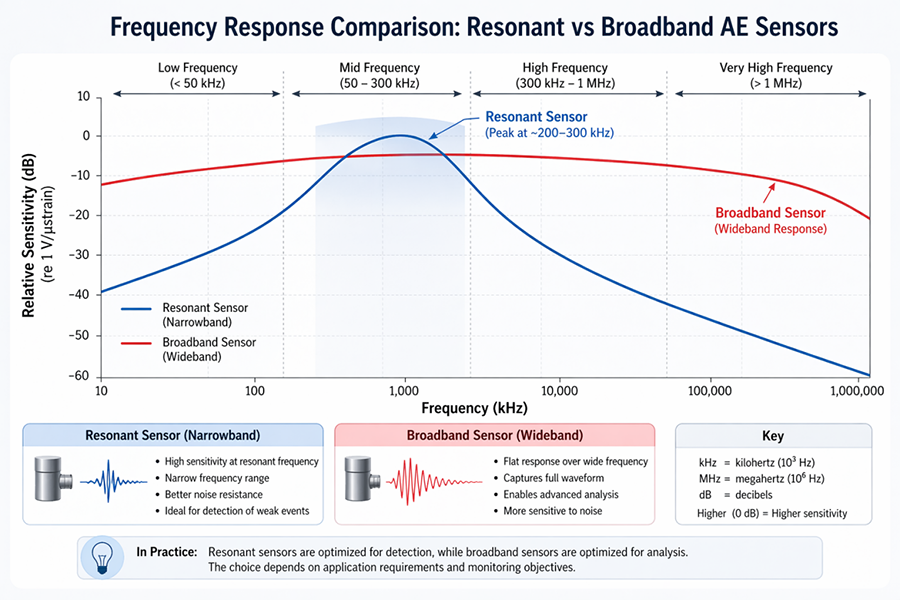
Note: The scale and the unit of the above graph may not be 100% accurate, but just for idea explanation purpose. For accurate and actual product specs, please contact us for details.
2.Key Difference at a Glance
| Aspect | Resonant Sensors | Broadband Sensors |
| Frequency response | narrowband | wideband |
| Sensitivity | High (at resonant) | Moderate |
| Signal detection | Optimized for specific signals | Capture full waveform |
| Noise resistance | Better in noisy environments | More sensitive to noise |
| Typical use | Detection-focused monitoring | Analysis-focused monitoring |
3.Resonant AE Sensors
How They Work
Resonant sensors are designed to amplify signals around a specific resonant frequency, typically in the range of 20–400 kHz (depending on design).
Advantages
- High sensitivity to weak signals
- Improved signal-to-noise ratio near resonance
- Effective in noisy environments
- Well-suited for event detection
Limitations
- Limited frequency coverage
- Distortion of waveform shape
- Less suitable for detailed signal analysis
Typical Applications
- Crack detection in metallic structures
- Pressure vessel testing
- Pipeline monitoring
- Field environments with high background noise
4.Broadband AE Sensors
How They Work
Broadband sensors are designed to provide a uniform response across a wide frequency range, allowing more accurate capture of waveform characteristics.
Advantages
- Captures full signal waveform
- Enables advanced signal analysis
- Suitable for frequency-based classification
- Supports research and diagnostics
Limitations
- Supports research and diagnostics
- More affected by environmental noise
- Requires better signal processing
Typical Applications
- Laboratory testing
- Composite material analysis
- Source mechanism identification
- Advanced signal processing studies
5.Signal Perspective: Detection vs Analysis
The most important distinction is:
Resonant sensors are optimized for detection, while broadband sensors are optimized for analysis.
Resonant Sensors
- Focus: "Did something happen?"
- Strength: detecting weak events
Broadband Sensors
-
Focus:
"What exactly happened?" - Strength: understanding signal characteristics
6.Frequency Response Comparison
Resonant Sensors
- Peak sensitivity at a specific frequency
- Rapid drop-off outside that range
Broadband Sensors
- Flat or gently varying response
- Covers wider frequency spectrum
In practice:
-
Resonant = magnifying glass (specific band)

-
Broadband = wide-angle lens (full view)

7.How to Choose the Right Sensor
Selecting between resonant and broadband sensors depends on your monitoring objectives.
Choose Resonant Sensors When:
- Detecting early-stage damage is critical
- Signals are weak
- Environment is noisy
- Real-time monitoring is required
Choose Broadband Sensors When:
- Signal analysis is required
- Frequency features are important
- Working in controlled environments
- Studying material behavior
8.Practical Engineering Trade-offs
In real-world applications, the choice is rarely absolute.
Trade-off Factors
- Sensitivity vs bandwidth
- Detection reliability vs analysis capability
- Noise resistance vs signal detail
9.Hybrid Sensor Strategies
In many advanced systems, engineers combine both sensor types.
Example Strategy
- Use resonant sensors for event detection
- Use broadband sensors for waveform analysis
This approach provides:
- high sensitivity, and
- rich signal information
10.Common Misunderstandings
1) "Broadband sensors are always better"
Not true. In noisy environments, resonant sensors may perform significantly better.
2) "Resonant sensors cannot be used for analysis"
They can be used, but their limited bandwidth restricts detailed interpretation.
3) "One sensor type fits all applications"
Different applications require different trade-offs. No single sensor is optimal in all cases.
Frequently Asked Questions
1) Which sensor type is more sensitive?
Resonant sensors are more sensitive at their resonant frequency.
2) Can broadband sensors detect small cracks?
Yes, but detection may be less reliable in noisy environments compared to resonant sensors.
3) Is it necessary to use both types?
Not always, but combining them can improve overall monitoring performance.
Related Topics
- Acoustic Emission Sensors Overview
- Sensor Coupling and Installation
- AE Signal Processing and Analysis
- Types of AE Sources
Summary
Resonant and broadband acoustic emission sensors represent two complementary approaches to signal detection and analysis. Resonant sensors provide high sensitivity for reliable detection, especially in noisy environments, while broadband sensors offer wider frequency coverage for detailed signal interpretation. The optimal choice depends on application requirements, and in many cases, combining both types yields the best results.
Not sure which AE sensor is suitable for your application?
Explore our AE sensor solutions or contact our engineering team for guidance.